Thermalization and dynamical multiscaling in voigt turbulence
The statistical theory of turbulence by A.N. Kolmogorov and later refined further by Uriel Frisch and G. Parisi using multifractal formalism of turbulence has enabled statistical physicist to unlock new doors. A consequence of it is dynamic multiscaling in turbulence. The motivation of this comes from the concepts of critical phenomena. Generally systems near Tc can be characterised by a unique time scale associated with a dynamic exponent say z. This enables us to ansatz scaling relations even in turbulence when the system has reach to its non-equilibrium steady state (NESS). However, turbulence is inherently multiscale, hence there is an infinity of such time scales which makes the hunt even harder. In 2002, D. Mitra and R. Pandit provided a detailed prescription to extract those time scales using shell model of turbulence (particulary GOY model); this is because shell models, by design with their local interactions, are essentially quasi-Lagrangian. Besides, understanding the origin of bottleneck phenomena in turbulent flows remains an open problem in nonequilibrium statistical physics. Bottlenecks appear as pronounced pileups of energy at the high–wavenumber end of the inertial range and are observed in direct numerical simulations (DNS), shell models, and experiments.
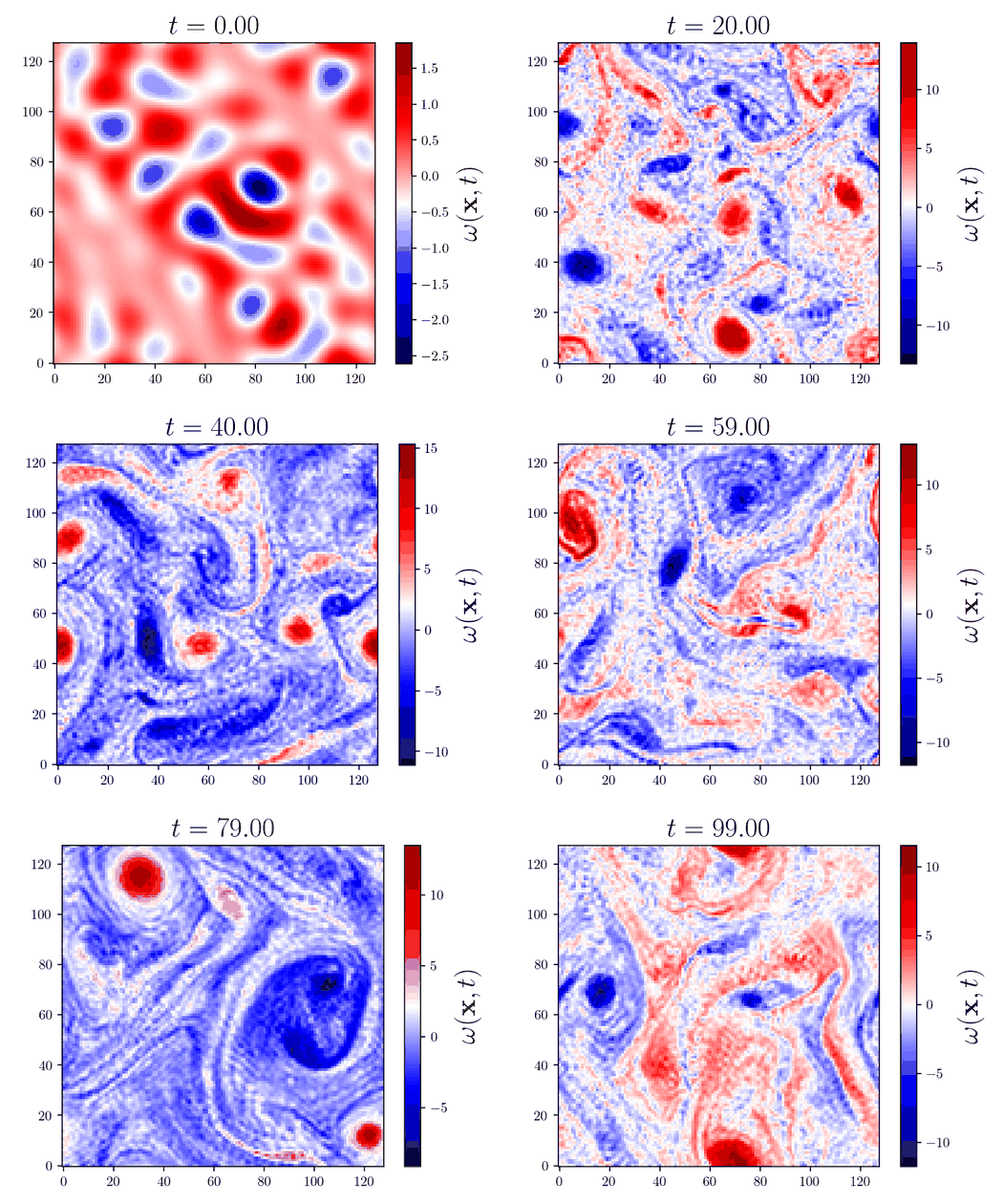
We study voigt model of turbulence which was first proposed by Oskolkov (1973). Just like the regularity problem of the Navier–Stokes equations, the regularity of the Voigt model of turbulence is also a well-posed mathematical problem. There has been significant mathematical development of this model (Titi et al. 2006; Kalantarov et al. 2009). Our focus is on the scaling behaviour of second-order structure functions (energy spectra) and dynamical scaling exponents. Through this we explain the botlleneck formations of turbulence.
References
- A. N. Kolmogorov, Local structure of turbulence in incompressible viscous fluid, Dokl. Akad. Nauk SSSR 30, 299 (1941).
- U. Frisch, Turbulence: The Legacy of A.N. Kolmogorov, Cambridge University Press (1995).
- G. Falkovich, Bottleneck phenomenon in developed turbulence, Phys. Fluids 6, 1411 (1994).
- D. Lohse and A. Müller-Groeling, Bottleneck effects in turbulence, Phys. Rev. Lett. 74, 1747 (1995).
- Z.-S. She, G. Doolen, R. H. Kraichnan, and S. A. Orszag, Energy spectra and intermittency in turbulence, Phys. Rev. Lett. 70, 3251 (1993).
- P. K. Yeung and Y. Zhou, Universality of the Kolmogorov constant in turbulence, Phys. Rev. E 56, 1746 (1997).
- T. Gotoh, D. Fukayama, and T. Nakano, Velocity field statistics in turbulence simulations, Phys. Fluids 14, 1065 (2002).
- Y. Kaneda et al., High-resolution direct numerical simulations of turbulence, Phys. Fluids 15, L21 (2003).
- T. Ishihara, T. Gotoh, and Y. Kaneda, Study of high–Reynolds-number turbulence, Annu. Rev. Fluid Mech. 41, 165 (2009).
- D. A. Donzis and K. R. Sreenivasan, The bottleneck effect and its dependence on Reynolds number, J. Fluid Mech. 657, 171 (2010).
- D. Mitra, J. Bec, R. Pandit, and U. Frisch, Is bottleneck a finite Reynolds number effect?, Phys. Rev. Lett. 94, 194501 (2005).
- A. G. Lamorgese, D. A. Caughey, and S. B. Pope, Direct numerical simulations and spectral bottlenecks, Phys. Fluids 17, 015106 (2005).
- D. Biskamp, E. Schwarz, and A. Celani, Energy spectra in turbulence and bottleneck effects, Phys. Rev. Lett. 81, 4855 (1998).
- D. Biskamp and W.-C. Müller, Scaling properties in turbulent flows, Phys. Plasmas 7, 4889 (2000).
- W. Dobler, N. E. L. Haugen, T. A. Yousef, and A. Brandenburg, Simulations of turbulence and spectral effects, Phys. Rev. E 68, 026304 (2003).