Percolation on fractional Brownian Surfaces
Percolation theory is a classical example of simple system but complex physics which has been a long interest to mathematicians and physicists. In the last half a century, a great amount of work has been carried out to understand the critical behavior near pc. The behavior near the critical point is explained by scaling exponents and in different dimension we have been able to compute them (numerically with success and analytically with bit less confidence). There are approches developed using renormalization and field theory also and they are able to provide a reasonable explaination to the observation made. We study this this problem on a fractional Brownian surface with different hurst exponent (H). We occupy the lattice according to the h(x,y) which is height field and study percolation on this. Indeed its a discontinuous phase transition.
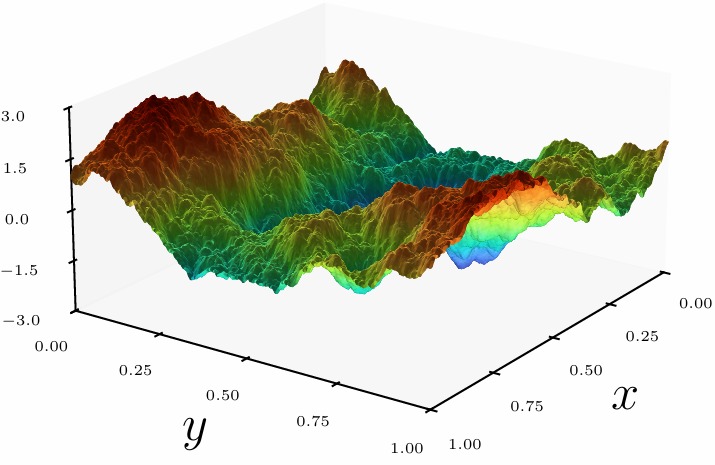
In particular, we focus on the limit H → 0. We use a universal gap-scaling approach to analyse the transition and its characteristics, following ideas developed in Universal Gap Scaling in Percolation(Fan, Meng, Liu & Saberi, Nat. Phys. 16, 455–461, 2020).
References
- D. Stauffer and A. Aharony, Introduction to Percolation Theory, Taylor & Francis (2018).
- A. A. Saberi, Recent advances in percolation theory and its applications, Phys. Rep. 578, 1 (2015).
- H. E. Stanley, Scaling, universality, and renormalization, Rev. Mod. Phys. 71, S358.
- D. Achlioptas, R. M. D'Souza, and J. Spencer, Explosive percolation in random networks, Science 323, 1453 (2009).
- R. A. da Costa et al., Explosive percolation transition is actually continuous, Phys. Rev. Lett. 105, 255701 (2010).
- J. Nagler et al., Continuous percolation with discontinuities, Phys. Rev. X 2, 031009 (2012).
- R. M. D'Souza and J. Nagler, Anomalous critical phenomena in explosive percolation, Nat. Phys. 11, 531 (2015).
- Y. S. Cho et al., Avoiding a spanning cluster in percolation models, Science 339, 1185 (2013).
- A. Coniglio and A. Fierro, Correlated percolation, Springer (2009).
- J. Fan, J. Meng, Y. Liu, A. A. Saberi, J. Kurths, and J. Nagler, Universal gap scaling in percolation, Nat. Phys. 16, 455 (2020).
- M. Li, J. Wang, and Y. Deng, Explosive percolation obeys standard finite-size scaling, Phys. Rev. Lett. 130, 147101 (2023).
- G. Györgyi et al., Finite-size scaling in extreme statistics, Phys. Rev. Lett. 100, 210601 (2008).
- S. Fang, Z. Zhou, and Y. Deng, Percolation effects in FK Ising model, Phys. Rev. E 103, 012102 (2021).
- H. Hu, R. M. Ziff, and Y. Deng, No-enclave percolation, Phys. Rev. Lett. 117, 185701 (2016).